
Event and Campaign Systems
Event Badge Printing Options Compared: What Conference Organisers Actually Need
Badge printing looks like a small detail until the doors open. The wrong choice shows up as long queues at registration, badges torn off lanyards by mid-morning, blank-looking badges flipped the wrong way round, or a stack of pre-printed templates that’s useless the moment an attendee list changes.
Underneath the hardware, organisers are really weighing the same handful of questions. This guide lays out those questions, then compares the main badge printing methods — sticker labels, direct thermal paper badges, pre-printed stock and on-demand full-colour badges — against each one.
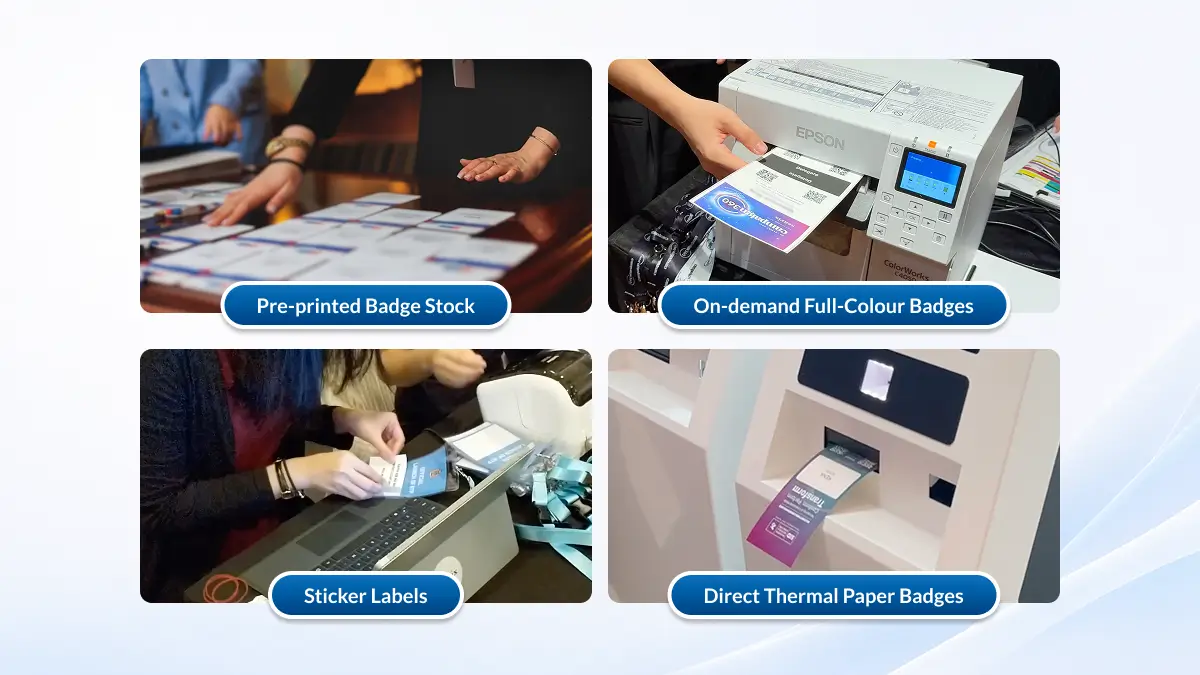
What organisers actually care about
- Double-sided printing. A badge spins on its lanyard constantly. If only one side is printed, half the time people see a blank back. Double-sided badges keep the name and details visible whichever way they hang.
- Tear resistance. The most common failure is the lanyard hook tearing through the badge hole. Folded or reinforced stock survives a multi-day event; a single loose sheet often doesn’t.
- Water and smudge resistance. Badges get rained on between venues, splashed at receptions, and handled with damp hands. The print shouldn’t run or smear.
- Print speed. Every second at the counter is queue time. Faster printing clears arrivals faster — this matters most at large, peak-arrival events.
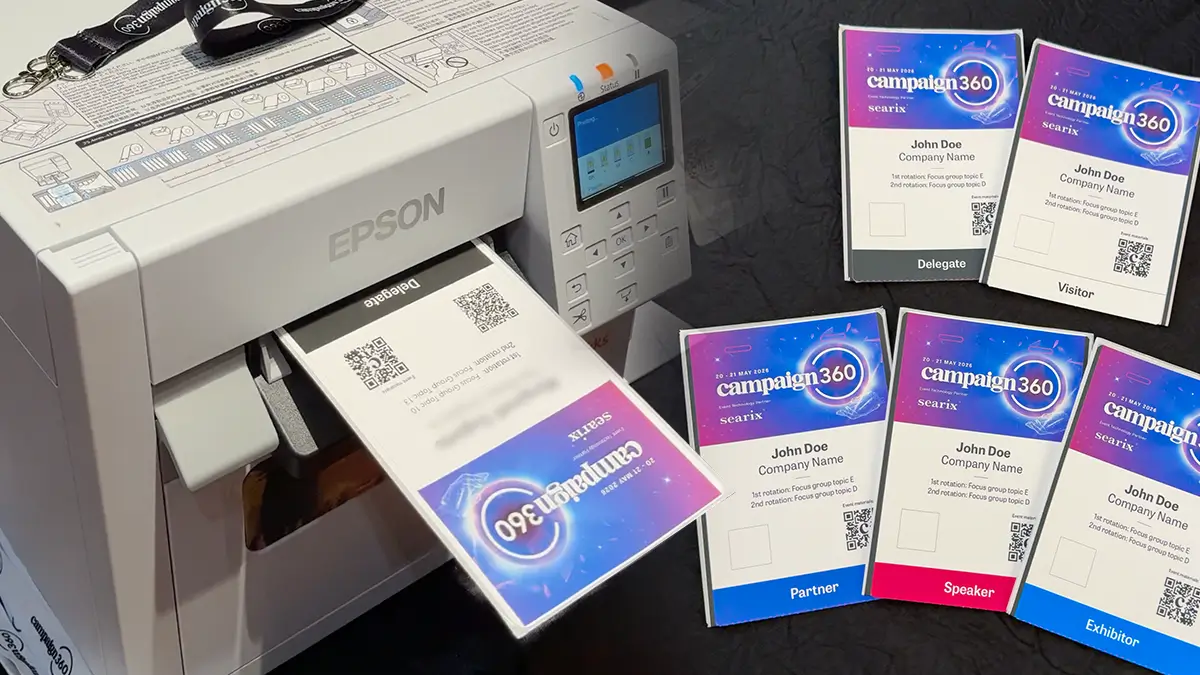
- Colour. Business events often have multiple attendee types — speakers, VIPs, partners, press, general — who get different access. Colour-coded badges let staff tell them apart at a glance.
- Badge content. A badge usually carries a QR code (or, in some setups, RFID) tied to the guest’s identity, used for QR check-in, session access control and exhibitor lead capture.
- Cost. Per-badge cost, consumables and setup all add up — and the cheapest option isn’t always the right one once flexibility and durability are priced in.
For events run outside your home market, there’s an eighth question — logistics and fallbacks — which we cover at the end.
The main badge printing methods
Pre-printed badge stock
The most economical method of printing badages is via digital pre-printing of badges. This involves knowing the full name list of the guests in advance, merging them into the badge’s key visual artwork, and sending them to a print factory for digital printing.
When combined with on-site printing methods, the badge stock with the event’s key visual printed at a factory ahead of time, then personalised on-site (both in black or in colour). It looks the most polished and is economical at very high volumes — but you commit to the design weeks out, and different attendee types mean different pre-printed batches.
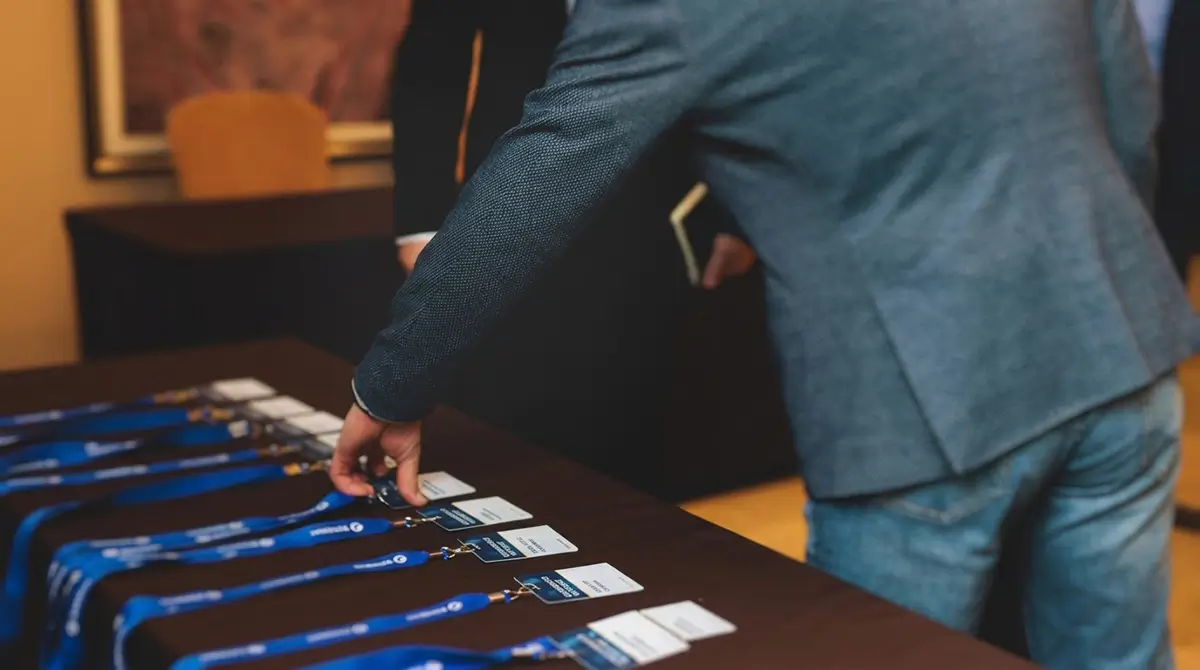
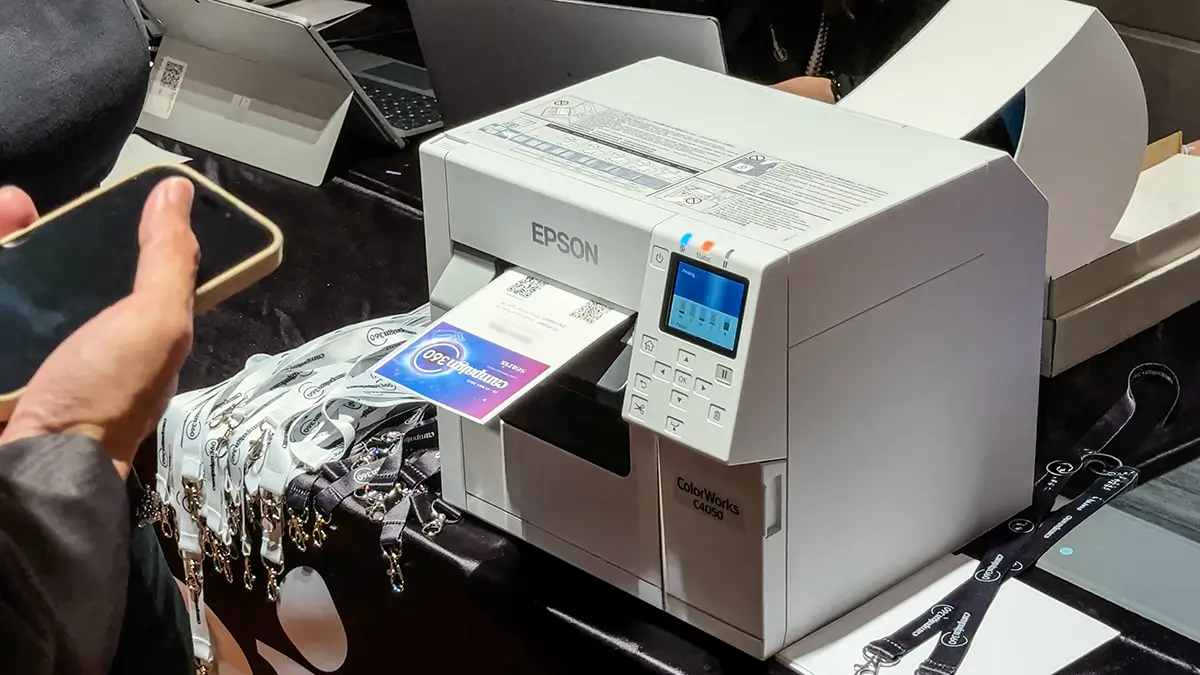
On-demand full-colour badges (Epson ColorWorks C4050)
Prints each badge in full colour onto blank stock at check-in, so any counter can produce any attendee type’s design with no pre-sorting and no template stacks. Badges are double-sided (folded), tear-resistant, and water- and smudge-resistant (though not fully scratch-proof). Trade-offs: about 20 seconds for a double-sided badge — slower than thermal — and colour ink is a consumable cost. Covered in depth in our guide to on-demand full-colour badge printing.
Sticker labels
The fastest, most flexible option. Labels print in black and can be stuck straight onto clothing or onto a pre-printed badge template. Great for networking and internal events where throughput matters more than a polished printed badge. Limitation: black-only, and a single label isn’t a double-sided badge on its own.
Direct thermal paper badges
The conference workhorse. Thermal printers (e.g. Zebra ZD621) personalise badges in black at roughly five seconds each, and fan-fold stock folds into a tear-resistant, double-sided badge. The catch: thermal is black-only, so any colour or branded design has to be pre-printed onto the stock in advance — usually a 1+ week lead time — and each attendee type needs its own template.
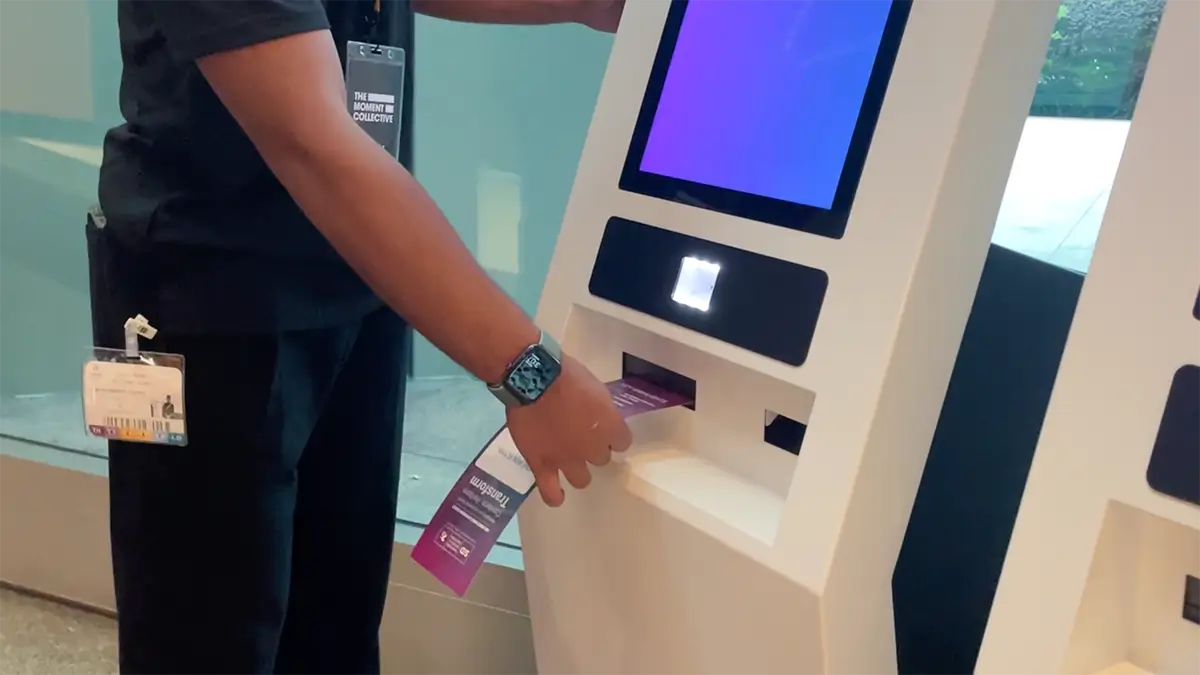
At a glance: badge printing methods compared
| Criterion | Sticker labels | Direct thermal paper (ZD621) | Digital pre-print | On-demand full colour (C4050) Best fit |
|---|---|---|---|---|
| On-Site Print Colour | Black only | Black only | N/A | Full colour, 1200 dpi |
| Different design per attendee type, on-site | Limited | Limited (one template per design) | Yes (digital pre-print) | Yes — any design, any counter |
| Double-sided | No (single label) | Yes (fold) | Yes | Yes (fold) |
| Tear-resistant | Label-dependent | Yes | Yes | Yes |
| Water / smudge-resistant | Label-dependent | Yes | Yes | Yes |
| On-site print speed | Very fast | ~6 sec (double-sided) | N/A | ~20 sec (double-sided) |
| Lead time before event | Minimal | 2 weeks for key-visual pre-print | ~1 week | None for design; optional 2 weeks key-visual pre-print |
| Relative cost | Low | Moderate | Low-moderate | Higher (ink consumables) |
| Best for | Networking, internal, high-volume | Confirmed single design, speed, budget | Confirmed premium design at scale | Multi-type events, last-minute changes, colour |
How to choose
- Choose pre-printing when the design and guest is locked, the event is smaller; or pre-print the designs for direct thermal or full colour printing when a premium factory finish matters more than last-minute flexibility.
- Choose sticker labels when speed and simplicity win — networking nights, internal town halls, high-volume arrivals where a printed badge holder isn’t essential.
- Choose direct thermal when you have a single confirmed design, want the fastest per-badge printing, and are watching budget — and you can prepare templates a week or more ahead.
- Choose on-demand full colour when you have multiple attendee types, expect late changes to the guest list or categories, or simply want colour-coded badges — and you can trade a few extra seconds per print for that flexibility.
Many events use a mix — for example colour badges for speakers and VIPs, stickers for a high-volume side session.
Searix provides both direct thermal and on-demand colour printing as managed services, so this guide isn’t about selling one machine. That said, we’ve seen demand shift toward colour on-site printing as more events run multiple attendee categories — though for a single, uniform attendee type, thermal is still the faster and more economical choice.
Running events overseas: logistics and fallbacks
For events outside your home market, the printing method is only half the decision — getting the hardware, consumables and a backup plan on-site matters just as much. Worth checking with any vendor:
- Equipment logistics: who ships or sources the printers, and how customs, power and connectivity differ at the venue.
- Consumables: colour printing needs ink and the right blank stock on hand; thermal needs the correct media. Running out mid-event is the failure mode to avoid.
- Fallbacks: what happens if a printer fails? A sensible setup keeps a spare unit and a simpler fallback (e.g. sticker labels) ready so registration never stops.
- On-site support: trained technicians who can resolve issues in real time rather than over email.
Searix runs managed registration for events in Singapore and has supported events across the wider region; for overseas requirements, the right method-and-fallback mix is best scoped per event.
Where Searix fits
Searix provides all of these as a managed service — sticker labels, direct thermal paper badges, pre-printed stock and on-demand full-colour badges — matched to your event rather than sold as one-size-fits-all, alongside RSVP microsites, QR check-in, access control and lead capture. To talk through the right fit for your conference or exhibition, see our event registration and badge printing service.
Frequently Asked Questions
Common questions about choosing and comparing event badge printing.
What’s the best badge printing method for a conference?
There’s no single best method — it depends on your priorities. Direct thermal is fastest and most economical for a single confirmed design; on-demand full-colour printing is best when you have multiple attendee types or expect late changes; sticker labels suit high-volume, informal events. Match the method to whether speed, colour, durability or flexibility matters most.
Are colour event badges worth it over black-and-white?
Colour is most worth it when an event has multiple attendee types — speakers, VIPs, partners, press, general — who receive different access or treatment, because colour-coded badges let staff distinguish them instantly. For a single uniform attendee type, black-only thermal printing is faster and cheaper.
How far in advance do I need to arrange badge printing?
On-demand full-colour printing needs no lead time for the design, because badges print onto blank stock at check-in. Pre-printed stock and colour templates for thermal printers typically need one to two weeks to produce.
Can event badges be double-sided and waterproof?
Yes. Folded fan-fold stock produces a double-sided badge so the name shows whichever way it hangs, and pigment-ink colour printing (such as the Epson ColorWorks C4050) is water- and smudge-resistant. Note that water-resistant is not the same as scratch-proof.
Need something similar?
Plan your next event experience with Searix
Bring us into the brief early and we will recommend the right mix of registration, engagement, lead capture and on-site support.
Talk to Searix